
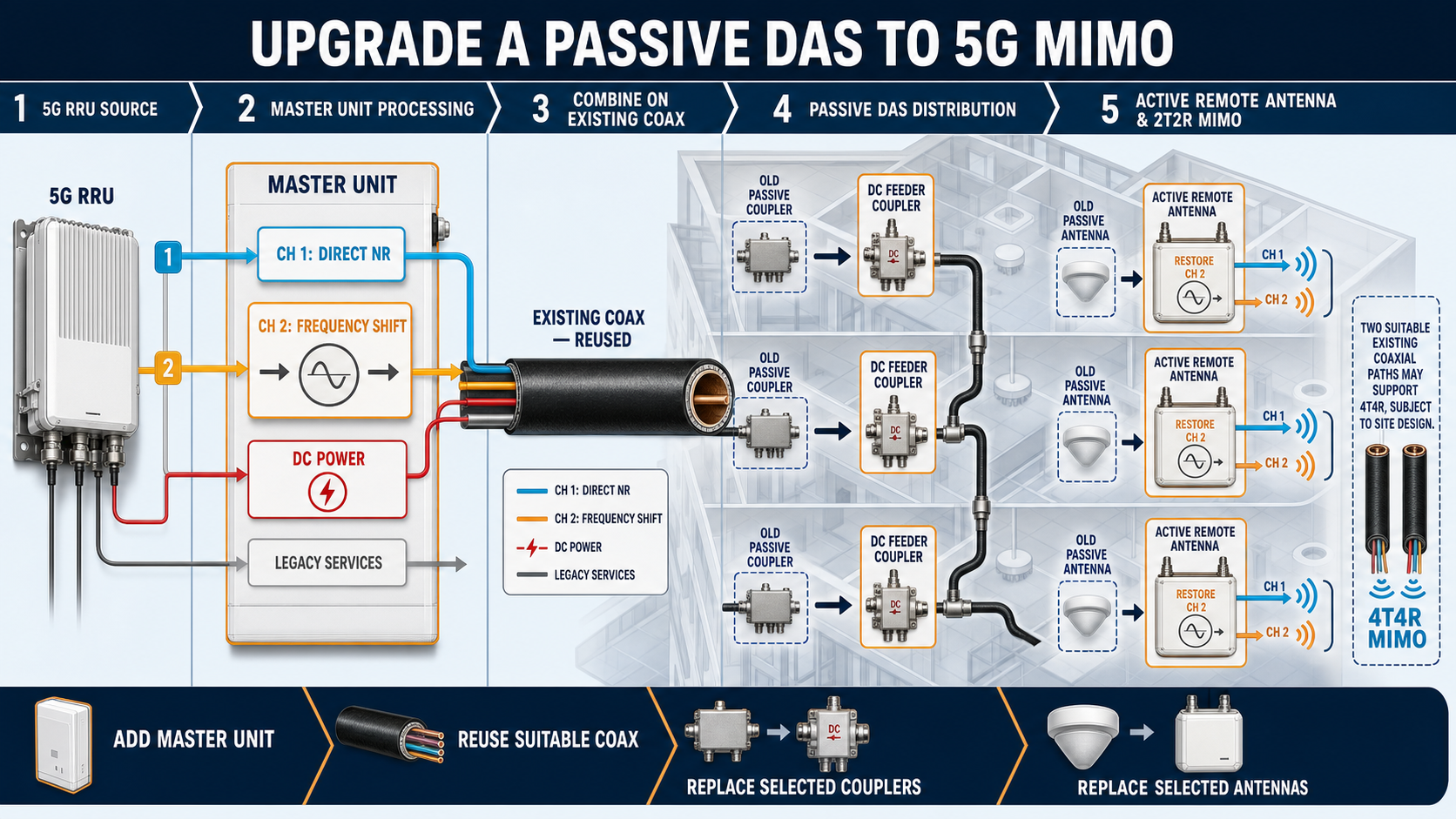
Sometimes yes, but only after a real site survey. If the existing passive DAS still has usable coax, acceptable loss and PIM behavior, enough band support, and a topology that can carry the required MIMO paths, a selective upgrade can be practical. If the site needs major new capacity, heavy sectorization, or the feeder network is already near its limit, forcing reuse usually creates rework later.
That is the real answer most buyers need. The question is not whether coax reuse sounds attractive in a brochure. The question is whether the existing network can still support the 5G indoor coverage target after you account for feeder loss, component condition, MIMO order, and site constraints.
Why This Question Comes Up So Often
Many buildings already have a passive DAS in place. The cable routes are hidden above ceilings, access windows are limited, and the venue owner does not want a major new construction cycle just to add 5G indoor coverage.
At the same time, the performance target has changed. MIMO is usually the preferred architecture when the goal is higher throughput and capacity. A simpler SISO approach may cost less, but it normally delivers lower speed and lower capacity than a MIMO design.
That is why existing passive DAS networks become a decision point. Some are still good retrofit candidates. Others were never built for the bands, losses, and branch behavior that 5G indoor coverage now needs.
Start With One Honest Question
Do you want to preserve cable routes, or do you want to preserve network performance?
In a good retrofit project, you can keep both. In a bad retrofit project, the team protects the old cabling but gives away too much signal quality, too much capacity, or too much time during commissioning.
The safer way to decide is to treat coax reuse as an engineering hypothesis. Then test it.
What Must Be True Before Reusing the Existing Passive DAS
1. The feeder network still behaves like a controlled RF path
The old cable map is not enough. You need current measurements.
In practice, that means the team should know:
- feeder lengths and branch layout
- connector types and splice history
- return loss and fault distance by segment
- whether the worst branches still fit the link budget
If those numbers are missing, the site is not ready for a confident yes.
2. The passive path supports the bands that matter for this project
Band support is one of the quickest ways to waste time on the wrong retrofit.
A passive DAS that was acceptable for an older band plan may not be suitable for the full band mix now expected on site. This is where old splitters, couplers, terminations, and connectors start to matter. A cable route is only useful if the passive components around it still fit the target frequency plan.
3. The topology can support the required MIMO order
This is where many retrofit conversations become too optimistic.
The issue is not simply whether the building has coax. The issue is whether the site can carry the required MIMO branches without creating an RF compromise somewhere else in the network.
For suitable projects, RFCOM’s current solution positioning allows a practical description: the system is designed to support 2T2R over one suitable coaxial path or 4T4R over two suitable paths, subject to project design and compatibility review.
That does not mean every existing passive DAS is a 4T4R candidate. Dense venues, complicated branch structures, or long feeder runs may still push the design toward a different architecture.
4. PIM and connector quality are under control
Passive DAS problems often look like a coverage problem at first and a hardware problem later.
If connector torque, plating condition, mounting details, or cable treatment are poor, the network may pass an initial inspection and still fail during acceptance or optimization.
That matters because a retrofit project is usually sold on reduced disruption. If the team has to reopen ceilings or chase branch-level faults after cutover, most of that advantage disappears.
5. The site can actually support the upgrade work
The survey should also look beyond pure RF. Head-end room details, roof access, building conditions, installation constraints, and available power and wall space often decide whether a project stays selective or becomes a partial rebuild.
A technically workable RF concept can still fail once the team discovers there is no clean power path, no equipment room space, or no acceptable route for the required component swaps.
A Simple Decision Framework
Good retrofit candidate
- Office, hotel, residential, hospital, or similar venue with moderate capacity demand
- Existing coax routes are known and testable
- Passive path supports the required bands
- Return loss, DTF, and PIM results are acceptable
- The design target is realistic for the required MIMO order
- The venue strongly prefers low-disruption works
Use caution
- Mixed old and new passive components with unclear history
- Long branches with little loss margin left
- Limited as-built documentation
- Unknown DC path or active-antenna placement constraints
- Multi-operator requirements not yet reconciled
Full redesign may be safer
- Stadiums, airports, tunnels, or other very high-capacity venues
- The project needs major new sectorization or higher-order MIMO beyond the practical retrofit path
- Feeder loss, return loss, or PIM results fail
- Key bands are not supported by the existing passive network
- The building needs a different transport or room architecture anyway
Retrofit Versus Rebuild: The Real Tradeoff
The usual sales framing is too simple. It turns the choice into reuse coax versus buy an optical DAS. Most projects are not that clean.
The real tradeoff is this:
- A selective retrofit can preserve cable routes and reduce construction scope, but only if the existing network is still predictable enough to commission.
- A full active or hybrid redesign can cost more up front, but it may be the lower-risk option when the site needs new capacity structure, new sector boundaries, or a cleaner operational baseline.
That is why the best early deliverable is not a price. It is a feasibility package with measurements.
What the Site Survey Should Collect Before Anyone Promises a Result
At minimum, the engineering team should collect:
- existing DAS diagram and feeder topology
- cable routes, feeder lengths, and branch inventory
- target 5G band, bandwidth, and MIMO requirement
- current antenna layout and any points planned for replacement
- baseline RSRP, SINR, and throughput or scanner data
- return loss, DTF, connector condition, and PIM results
- head-end room details, power availability, and wall space
- roof access, construction limits, and property restrictions
If those items are incomplete, the project is still in qualification, not in solution confirmation.
One Clear No-Fit Case
If the building needs high capacity across a dense venue, the feeder history is unclear, and the existing passive network already shows marginal RF behavior, do not try to save the project by forcing coax reuse.
That is usually the point where a full redesign becomes cheaper than repeated troubleshooting.
Practical Takeaway
An existing passive DAS can sometimes be upgraded to 5G MIMO. The right answer depends less on age and more on measurement.
If the feeder network still passes the RF basics, supports the target bands, and fits the required MIMO architecture, a selective upgrade can make sense. If the site needs a bigger capacity reset, cleaner segmentation, or the passive path already fails key tests, reuse becomes a liability.
The fastest way to make the right call is to ask for the current DAS drawings, feeder inventory, band plan, and a fresh set of return-loss and PIM results before anyone commits to a retrofit path.
Evaluating an existing indoor DAS? Contact RFCOM with the current DAS drawing, target bands, and available test data for an initial technical review.
