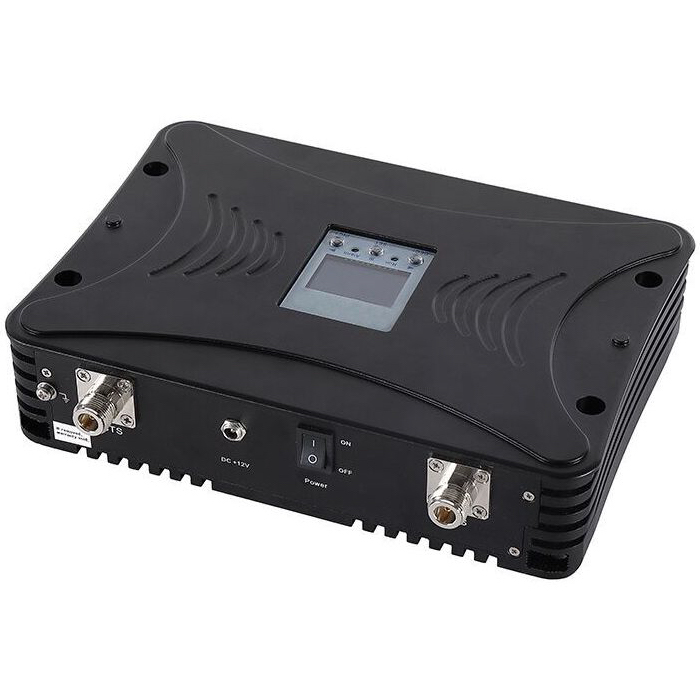
An RF repeater receives an available donor signal, amplifies selected uplink and downlink bands, and retransmits them to improve coverage in a defined area. It extends the donor network's signal; it does not create a new independent source of radio capacity.
A repeater may fit when a stable donor signal is available, the main problem is coverage rather than new capacity, antenna isolation can be achieved, and a new wired radio source is impractical. The decision should consider donor RSRP and SINR, donor-cell loading, target area, gain, output power, noise rise, oscillation risk, spectrum authorization, and acceptance requirements.
RFCOM supplies single-band, dual-band, triple-band, and penta-band repeater configurations with different gains, output-power classes, enclosures, and monitoring options. Support for 2G, 3G, 4G, or selected 5G applications depends on the exact model, frequency band, bandwidth, duplex mode, synchronization, and local approval.
Not by itself. A repeater uses the donor cell's spectrum and capacity. It can improve usable service where weak signal is the limiting factor, but user throughput still depends on donor-cell loading, bandwidth, radio conditions, interference, and the number of users. A capacity shortage may require a new radio source, small cell, or another architecture.
Selected RFCOM repeater models support web-based commissioning, remote monitoring, and defined alarm functions. Available measurements, alarms, protocols, remote controls, and network interfaces vary by model and project and must be confirmed in the approved specification.
A repeater is active signal-source equipment that extends a donor signal. A DAS is the distribution network that carries RF signals to multiple antennas. They are not always alternatives: a repeater can feed a small distributed antenna network, while a DAS can also be fed by an RRU, base station, or other signal source. The right design depends on coverage, capacity, site size, donor quality, cabling, monitoring, and multi-operator requirements.
The donor and service antennas must have enough isolation for the repeater gain and site conditions. Insufficient isolation can cause oscillation, instability, interference, or automatic gain reduction. Isolation should be measured at the relevant bands after installation, and the antenna positions, patterns, building loss, gain settings, and alarm behavior should be included in commissioning.
Provide the target bands and duplex mode, donor RSRP and SINR, donor-cell information, coverage area, building or terrain layout, required output power, donor and service antenna plan, expected isolation, indoor or outdoor environment, monitoring needs, power supply, user and capacity expectations, and local regulatory requirements.
RFCOM can review custom band combinations, gain, output power, filtering, enclosure, power supply, monitoring, interfaces, and project-specific installation requirements. The configuration remains subject to technical feasibility, spectrum rules, certification, and operator approval.