
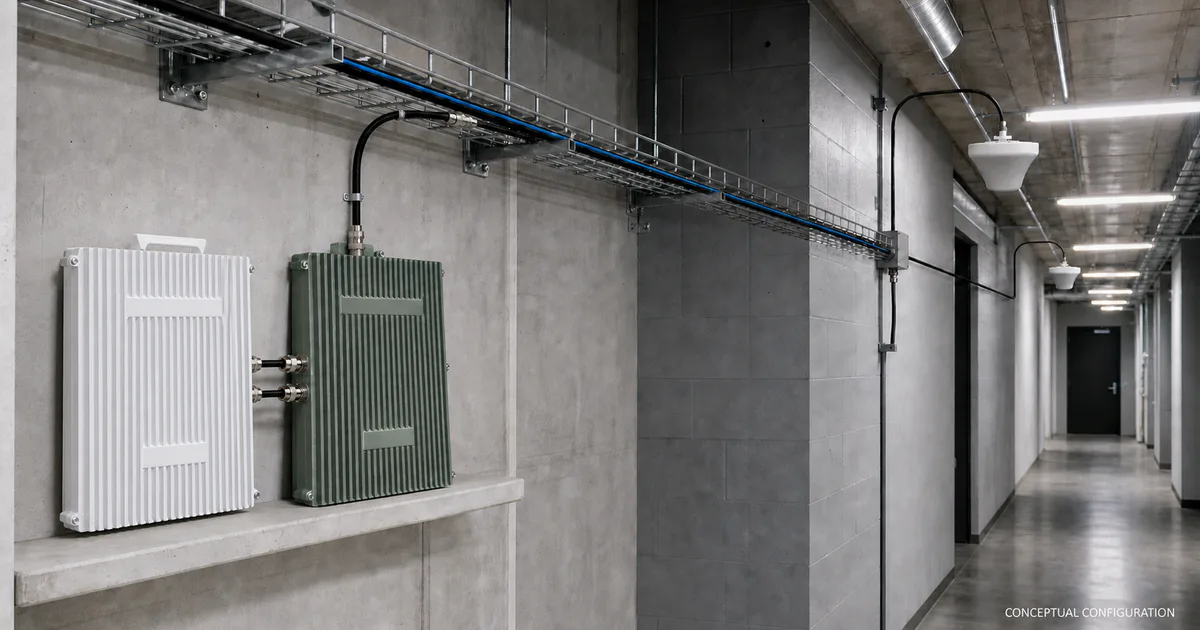
In brief: Depending on the approved RFCOM product version and project design, a frequency-shifting 5G DAS can transport two 5G RF/MIMO branches over one qualified coaxial path. One branch stays on a direct RF path. The second is translated to another frequency range for transport over the same coax, then restored at the remote end. The direct and restored branches provide the two RF paths used for a 2T2R antenna point.
That is a signal-transport method, not a promise that every existing passive DAS can be reused. The installed feeder condition, link budget, isolation, PIM, supported bands, passive-component behavior, power path, and system compatibility still have to be reviewed. A 4T4R design may use two qualified coaxial paths, but the exact topology remains version- and project-specific.
Why a legacy single-path DAS becomes a MIMO constraint
Many passive indoor DAS networks were designed around one coaxial route to each antenna point. That layout can continue to distribute supported services, but it creates an obvious question when a 5G upgrade calls for multiple radio branches: where do the additional RF paths go?
Simply connecting a 5G radio to an old feeder does not solve the problem. The network must preserve the required RF paths through the head-end, coax, passive components, and antenna point. It must also keep losses, return loss, PIM, isolation, and path balance within the project design.
Higher-frequency signals generally experience more attenuation over a given coaxial cable than lower-frequency signals. Published cable data sheets illustrate this frequency-dependent behavior, but the actual retrofit decision must use the installed cable type, route length, component losses, condition, and measured results. A drawing alone cannot establish that a feeder is reusable.
For a broader feasibility framework, see Can an Existing Passive DAS Be Upgraded to 5G MIMO?.
What 2T2R and 4T4R mean here
In practical radio-system shorthand:
- 2T2R describes two transmit and two receive radio chains.
- 4T4R describes four transmit and four receive radio chains.
For an indoor coverage system, those chains need corresponding RF paths through the distribution network. Installing a multi-port antenna by itself does not create additional radio branches, transmission layers, or capacity. The radio configuration, antenna ports, scheduler, user equipment, propagation conditions, and end-to-end DAS design all affect the MIMO result.
This distinction matters in retrofit discussions. Frequency shifting helps transport an existing radio branch through a qualified distribution path. It does not manufacture another radio resource.
What frequency shifting changes – and what it does not
Frequency shifting changes how one RF/MIMO branch is carried through the coaxial network. In selected RFCOM system versions, a branch can be translated to a transport frequency range that can coexist with the direct branch over the qualified coaxial path. At the remote unit, the translated branch is restored to the intended 5G band.
It does not:
- turn one physical cable into two physical cables;
- create a new radio branch, carrier, transmission layer, or spectrum resource;
- remove feeder loss, PIM, isolation, or compatibility limits;
- guarantee a particular throughput, coverage result, or MIMO rank;
- make every passive DAS, RAN vendor, band, feeder length, or topology compatible.
At RFCOM, we treat coax reuse as an engineering option to be qualified, not as a default answer.
A conditional 2T2R signal flow over one qualified coaxial path
The following description is approved at solution-principle level. Exact interfaces, frequency ranges, component types, power behavior, and path-management functions must match the selected product version and project design.
- Two 5G RF/MIMO branches enter the local or master unit. The branches originate from the required radio configuration; the DAS does not create them.
- One branch remains on the direct RF path. It continues through the designed distribution route subject to the normal link budget and component losses.
- The second branch is frequency-translated. The local or master unit shifts this branch to a transport frequency range selected by the approved system version.
- Both branches use the same qualified coaxial path. The direct branch and translated branch are combined into the distribution network with any supported legacy services and required DC-feeding arrangement.
- The remote unit restores the translated branch. At the selected antenna point, the remote unit converts the translated signal back to the intended 5G band.
- The direct and restored branches form the 2T2R RF paths. They are presented to the active antenna point as the two radio branches required by the approved design.
This architecture can reduce the need for a second new coaxial route at a suitable 2T2R retrofit site. Whether it is the right choice still depends on measurements and project acceptance criteria.
Why 4T4R may require two qualified coaxial paths
A 4T4R system has four transmit and four receive radio chains to preserve through the indoor distribution design. Depending on the approved RFCOM version and topology, the retrofit can support 4T4R over two qualified coaxial paths.
The exact branch mapping is version-specific. It should not be inferred from a generic diagram or from the 2T2R explanation above. Before confirming 4T4R, the design team must review the available feeder routes, radio interfaces, target bands, passive network, path isolation, power arrangement, remote-unit layout, and commissioning plan.
| Design question | Conditional RFCOM topology | What still requires project review |
|---|---|---|
| 2T2R at a selected antenna point | One qualified coaxial path may carry one direct and one translated/restored RF/MIMO branch | Product version, feeder condition, band, link budget, isolation, PIM, passive components, DC path, radio configuration, and acceptance tests |
| 4T4R at a selected antenna point | Two qualified coaxial paths may support the required four RF/MIMO branches | Version-specific branch mapping, two-path availability, end-to-end balance, component compatibility, power arrangement, and commissioning criteria |
Neither topology is universal, and neither row is a performance guarantee.
What can be reused, replaced, or requalified
A frequency-shifting retrofit is selective by design, but “selective” does not mean that the same three components are replaced on every site.
Potentially reusable, after qualification:
- serviceable coaxial feeder sections;
- compatible splitters, combiners, and branch hardware;
- supported legacy-service paths;
- existing routes and selected antenna locations.
Typically added or changed in the reviewed architecture:
- a local or master unit near the 5G radio interface;
- selected DC feeder components;
- active remote antenna units at the points chosen for MIMO coverage.
Replaced when the survey or design requires it:
- couplers, splitters, combiners, connectors, terminations, or feeder segments that do not meet the required band, DC, power, PIM, return-loss, or link-budget conditions.
The bill of materials comes from the site survey and approved design. It should never be copied from a generic topology drawing.
The qualification boundary
Before RFCOM confirms a coax-reuse design, the project team should review at least these inputs:
- current DAS schematic, feeder routes, branch layout, and cable lengths;
- cable and passive-component models, supported frequency ranges, and condition;
- target 5G bands, bandwidth, duplex mode, RRU configuration, and required MIMO order;
- insertion loss, return loss or fault-distance findings, PIM results, and connector condition;
- link budget and expected balance between direct and restored paths;
- isolation between relevant RF paths and any coexisting systems;
- DC continuity, DC blocking, grounding, surge protection, and remote power design;
- antenna-point locations, available feeder routes, installation access, and equipment-room constraints;
- baseline measurements and agreed post-upgrade acceptance tests.
These checks determine whether the existing infrastructure is suitable, which components can remain, and whether another DAS architecture is a better fit.
What to send RFCOM for an initial review
If you are evaluating 2T2R MIMO over existing coax, send RFCOM:
- the current DAS diagram and antenna schedule;
- feeder routes, cable types, lengths, and branch inventory;
- the target bands, bandwidth, and 2T2R or 4T4R requirement;
- RRU model, interfaces, and available radio-branch configuration;
- passive-component models and any recent return-loss, DTF, or PIM results;
- baseline RF and throughput measurements, if available;
- site photos, access limits, equipment-room details, and power constraints;
- the operator’s commissioning and acceptance requirements.
With those inputs, the engineering review can move from a generic retrofit concept to a version-specific topology and test plan.
The practical takeaway
Frequency shifting offers a practical way to transport two 5G RF/MIMO branches over one qualified coaxial path in selected RFCOM 2T2R designs. One branch remains direct; the other is translated for transport and restored at the remote end. For approved 4T4R designs, two qualified coaxial paths may be used.
The value of the method is not that it bypasses RF engineering. It is that it creates another design option when the installed coaxial infrastructure is still suitable and adding parallel cable routes would be difficult.
Planning a 5G indoor retrofit? Review the RFCOM 5G DAS solution and contact RFCOM support with the current DAS drawing, target bands, MIMO requirement, and available test data.
Sources
- RFCOM, 5G DAS Upgrade Solution for Passive DAS and Coax Reuse.
- ETSI, 3GPP TS 38.214 version 18.3.0 Release 18 – NR physical-layer procedures for data, including NR transmission-layer and antenna-port procedures.
- Times Microwave Systems, LMR-600 coaxial cable data sheet, as a manufacturer example of frequency-dependent coaxial attenuation. Actual project loss must be calculated and measured for the installed cable and route.
